Pool hall climate
Ventilation/dehumidification — the silent 24/7 load, with heat recovery. Part of the glass family — like our glass BESS, biogas plant and CHP.
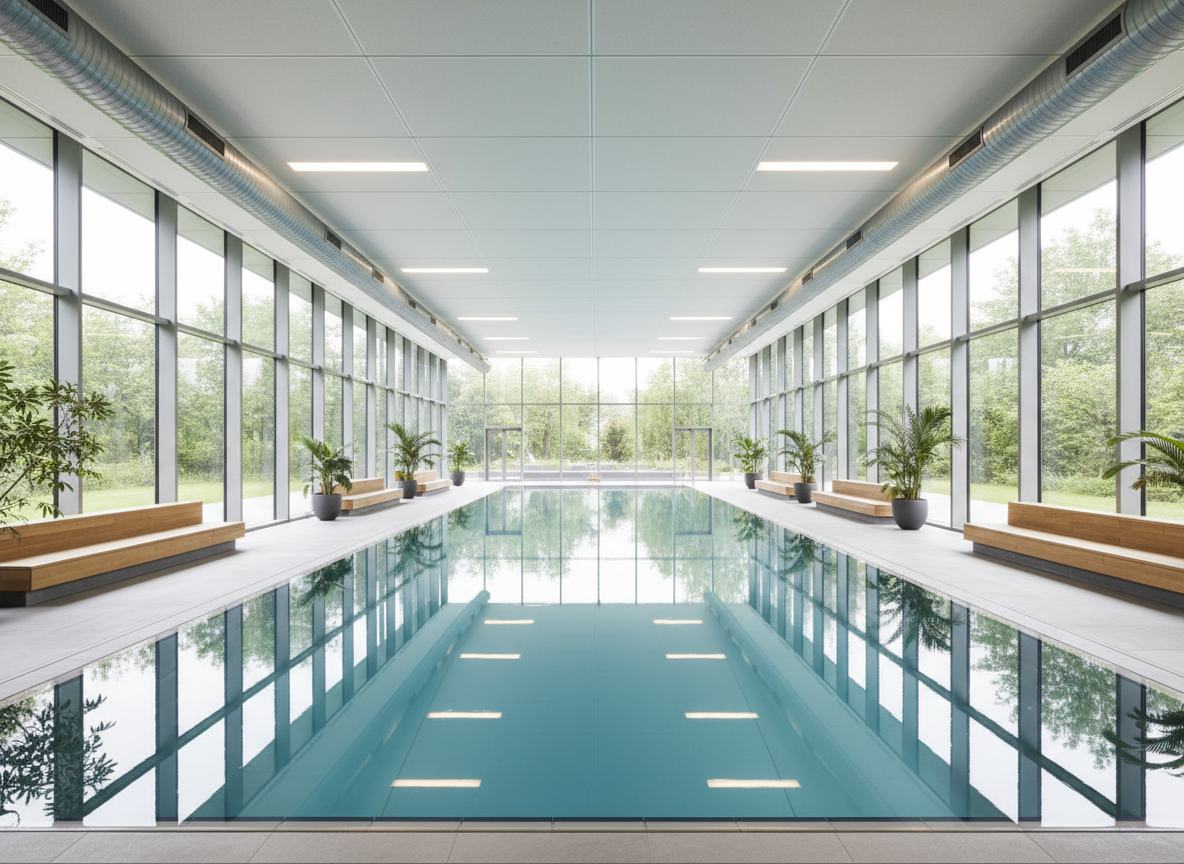
Outdoor air → Fresh air → Heat recovery → Heating coil → Hall → Exhaust
Ventilation/dehumidification — the silent 24/7 load, with heat recovery. Part of the glass family — like our glass BESS, biogas plant and CHP.
The pool hall itself is a subsystem: its climate of air temperature (~30 °C) and humidity (~55 % RH) governs evaporation, comfort and building fabric.
Every degree too cold or too dry drives evaporation above the standard (chain K02); the envelope also loses transmission heat (K12). The AI keeps temperature and humidity in the energy-optimal window.
Dehumidification with heat recovery (the ventilation standard for indoor pools, 36,000 m3/h):
Overview: The Glass Pool → · Markets: pool markets →
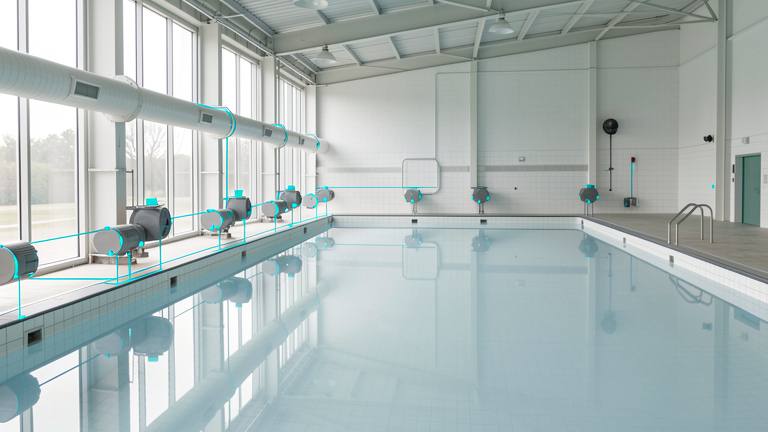
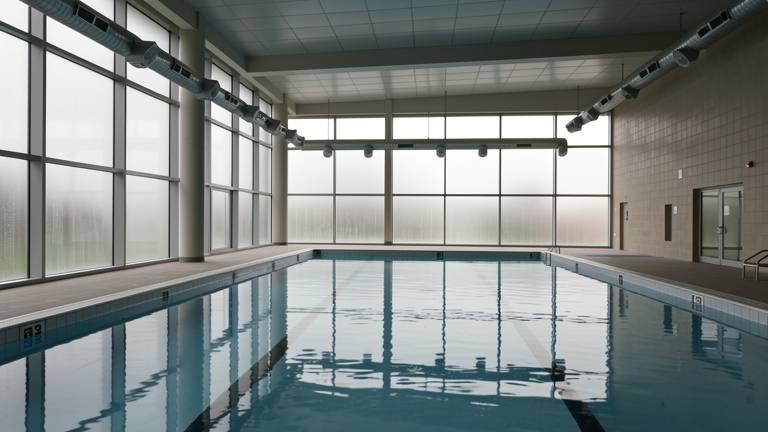
Monitored: continuously · hall humidity and surface temperatures
The scenario: Humidity creeps upward across the season. The dew point reaches the glazing before any comfort limit is exceeded, and the building fabric pays first.
Method proven on a live European reference aquatic center; presented anonymously.
Estimate from metered / design values. Zero-grid-import windows are real (metered).
Grounded in the applicable national standards for pool water treatment, plant energy performance and building energy performance. Same knowledge base as the European reference site; presented anonymously.
The applicable standard defines the target hall climate: air temperature 30 °C ± 2 K, relative humidity 55 % ± 5 %. Outdoor-air rate at least 30 m³/h per person at full occupancy, at least 4 L/(s·m² of water surface) in base mode. For a hall with 355 m² water surface: 4 × 355 × 3.6 = 5,112 m³/h minimum; in practice The applicable standard recommends ~16,000 m³/h for comfort and pollutant removal (trihalomethanes). Heat recovery via plate exchanger at 65-75 % efficiency is standard.
Basis: the applicable national standard
Evaporation from the water surface is the dominant heat loss in an indoor pool (60-80 %). Smith/Löf variant of the Carrier formula: m_evap [kg/h] = β × A [m²] × (p_w_pool − p_w_hall) [kPa]. β-coefficient per the pool energy guideline (evaporation and ventilation) Tab. 4: 0.013 unused pool (covered), 0.040 normal use, 0.080 wave/diving pool. Evaporation enthalpy at 30 °C: 0.694 kWh/kg. Pool saturation vapour pressure via the Magnus formula: 611.2 × exp(17.62 × t / (243.12 + t)) Pa.
Basis: the applicable national standard
The national buildings energy act the national buildings energy act 2024 treats pools as non-residential buildings. Mandatory air-conditioning inspection every 4 years (ventilation > 12 kW). On change of ownership or major refurbishment, tighter envelope U-values apply (external wall U ≤ 0.24 W/(m²·K)). A demand-based energy certificate is required above 250 m² of heated floor area. A hall pool with 1,800 m² of envelope at U=0.8 does not meet new-build standards — so grant funding for envelope refurbishment (up to 35 % rate) is available.
Basis: the national buildings energy act 2024 (the national buildings energy act)
When hall humidity is too high (rH > 65 %) the traditional fix is raising the outdoor-air rate — which doubles the heat loss in winter. The modern approach is a dehumidifying heat pump (sorption wheel or reversible compressor) that removes water directly from the hall air without raising outdoor air. Investment 30-80 k€ depending on size, payback 4-7 years. On a hall running 16,000 m³/h in cold winters a sorption wheel can save 30-50 % of the ventilation heating energy.
Basis: the applicable national standard
The applicable standard governs ventilation with hygiene requirements. For pool halls: filter class F7 minimum, 6-month service interval. Plate heat-recovery exchangers must be able to drain condensate. Hygiene inspection every 2 years (logged in the maintenance record). Pool-specific: because of chloramines, corrosion-resistant materials (V4A stainless, plastic) are required in the exhaust stream; aluminium exchangers are not permitted in the pool-hall exhaust air.
Basis: the applicable national standard
Stromfee.US licenses the pool & wellness HVAC AI — proven in Europe, deployed on your existing plant. Single property, portfolio or chain.
Request software license →