Rooftop PV
Power/PV — controllable load, grid draw toward zero. Part of the glass family — like our glass BESS, biogas plant and CHP.

PV → LV distribution → AI controller → Pool load → Grid → BESS
Power/PV — controllable load, grid draw toward zero. Part of the glass family — like our glass BESS, biogas plant and CHP.
The rooftop PV (reference 243 kWp, plan up to 643 kWp) supplies on-site power. Without control the surplus is exported to the grid for a few cents.
The AI runs the PV as a controllable load: it starts heat pump, circulation and buffer charging preferentially when the sun shines — self-consumption rises from ~30 % to over 50 % (chain K07).
PV as controllable load, LV distribution, grid as buffer:
Overview: The Glass Pool → · Markets: pool markets →
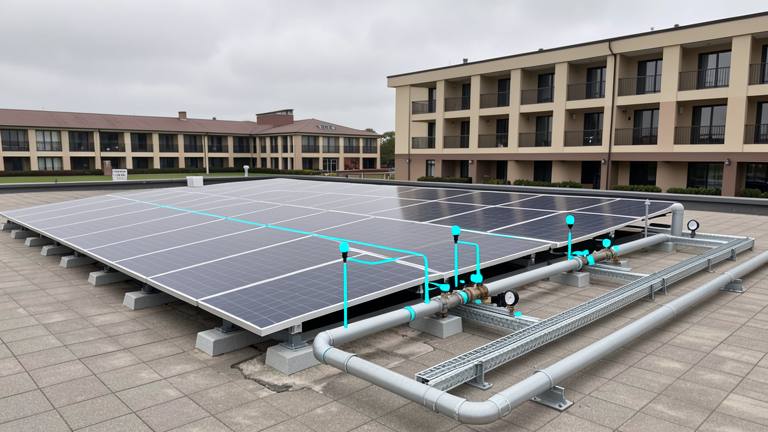
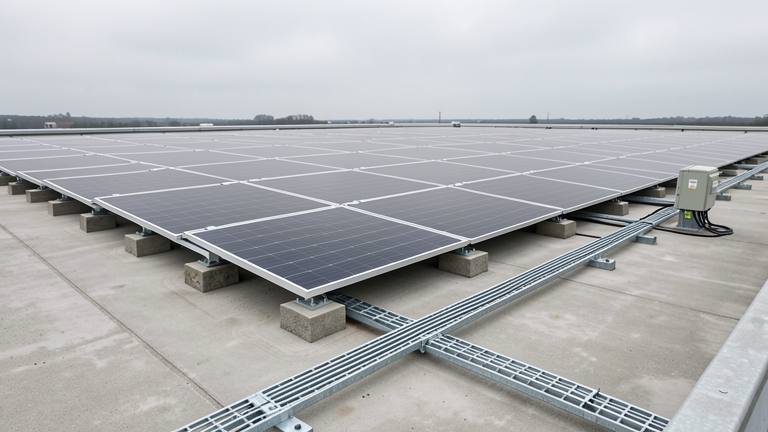
Monitored: continuously · yield per string
The scenario: One string quietly underperforms behind soiling or a failing connector. The total yield still looks plausible, so the loss survives until someone reads the strings separately.
Method proven on a live European reference aquatic center; presented anonymously.
Estimate from metered / design values. Zero-grid-import windows are real (metered).
Grounded in the applicable national standards for pool water treatment, plant energy performance and building energy performance. Same knowledge base as the European reference site; presented anonymously.
Pools have a daytime load profile that fits PV well: pumps run during opening hours (typically 9 a.m.-9 p.m.), ventilation ramps up in day operation, heat-pump heat-up can be time-shifted. Without load management the self-consumption ratio is 30-40 %. With load management (all main loads controlled): 60-75 %. Adding BESS: 80-90 % is possible but only economic at high day-ahead spreads. Example potential: 643 kWp × 815 kWh/kWp/a = 524 MWh/a; at 60 % self-consumption = 314 MWh/a × (0.25 − 0.06) €/kWh = 60 k€/a of extra saving from load management.
Basis: Practice studies
The market master-data registry requires all PV and storage systems above 800 W to be registered within one month of commissioning. An existing 243 kWp roof PV is registered; a new 400 kWp car-port PV must be registered at commissioning. Registration is a precondition for feed-in tariffs, and the registry entry is often required as proof for grant funding.
Basis: Grid registry (BNetzA MaStR)
The applicable standard governs the connection of generation systems to the low-voltage grid. Systems above 30 kVA must participate in the grid-operator control scheme — the operator may curtail feed-in when the grid is critically loaded. A pool with 643 kWp is well above this threshold. The local low-voltage cluster score is 7/10, so the probability of curtailment is low but technically possible. Load management lowers this risk because less power is fed in.
Basis: the applicable national standard
Stationary battery storage (BESS) in a public pool is currently not economical at sites without redispatch stress and with a low day-ahead spread. Typical site: redispatch score 0/10 (no curtailment), grid-control score 7/10 (little curtailment leverage). Day-ahead spread ~150 €/MWh — too little for BESS arbitrage. Re-evaluate in 2028/29 if the spread exceeds 200 €/MWh or a grant co-funds storage. For now, load management (synchronising HP/ventilation/filters to PV) with a payback below 1 year is the far better investment.
Basis: Practice + site analysis
Load-management systems switch shiftable loads in sync with PV production. In a pool the ideal moves are: modulate the heat pumps onto the PV profile, raise ventilation stages when PV surplus exists, run the main filter pumps during the day, dim lighting during daylight. Investment 30-60 k€ depending on the number of switching devices and building-management integration. Self-consumption ratio typically rises from 30 % to 55-70 % with broad integration. Precondition: all main loads are Modbus/MQTT-capable.
Basis: Practice (e3dc, ESL, Solarwatt)
Stromfee.US licenses the pool & wellness HVAC AI — proven in Europe, deployed on your existing plant. Single property, portfolio or chain.
Request software license →