Standards & norms What the rules require — Surge tank (indoor)
Grounded in the applicable national standards for pool water treatment, plant energy performance and building energy performance. Same knowledge base as the European reference site; presented anonymously.
What does Practice (KSB, FLL) require regarding Surge-tank insulation?
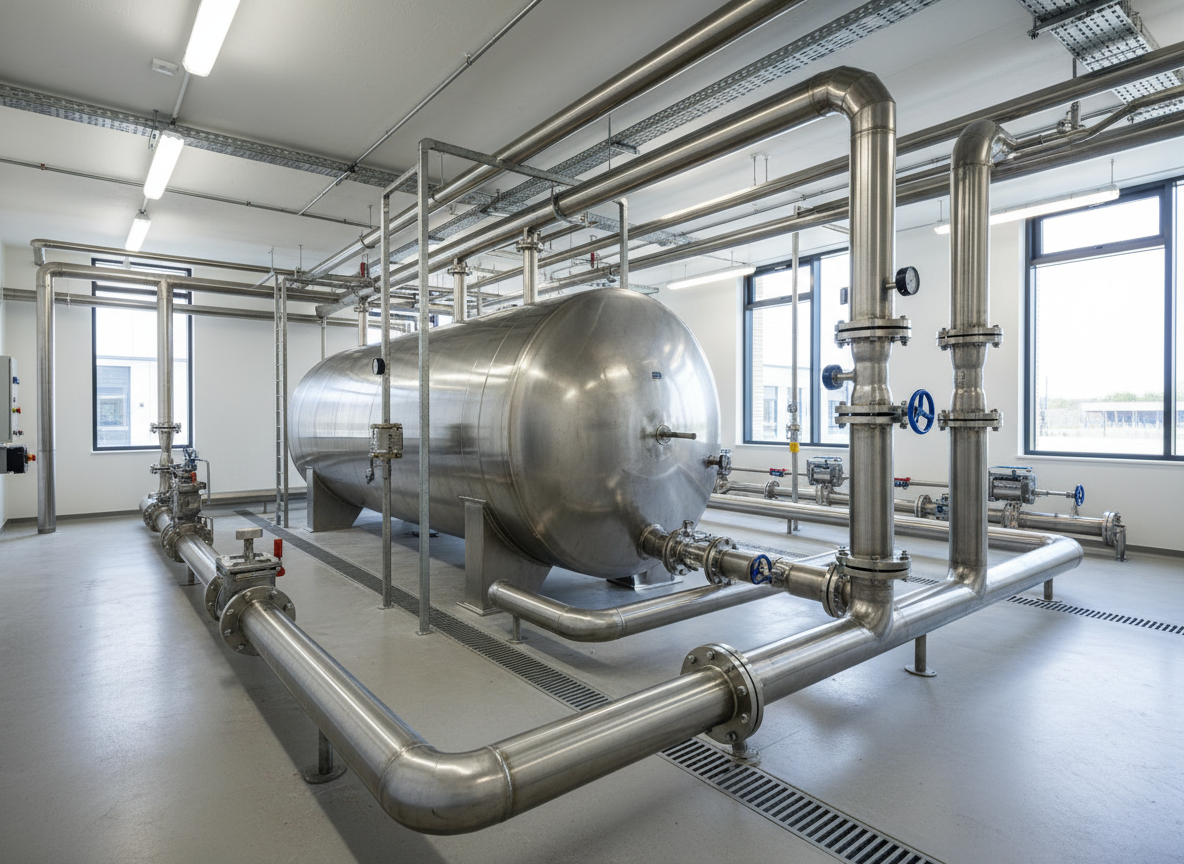
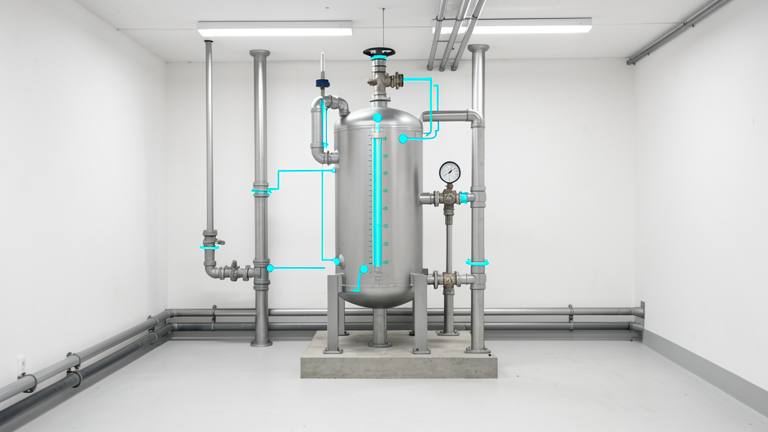
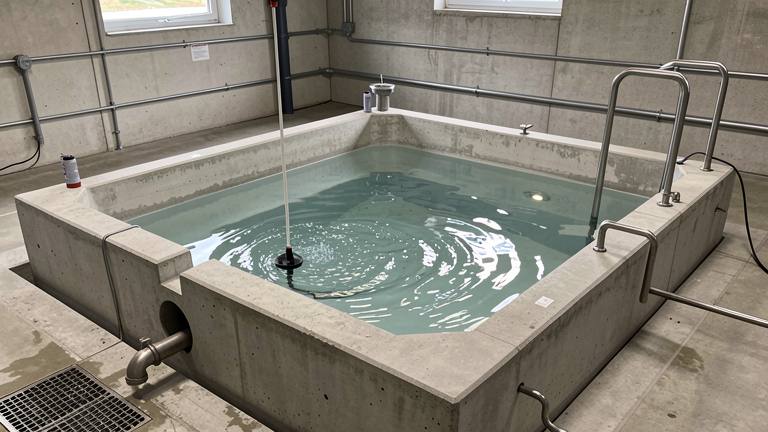
Uninsulated surge tanks (steel or concrete, in the ground) lose heat continuously. Uninsulated U-value: 2.0 W/(m²·K) against ground (12 °C). Insulating with 80 mm PUR rigid foam reduces U to 0.32 W/(m²·K) — a factor of 6. Investment: 250-350 €/m² of tank wall including water-tightness and mould protection. For a 55 m² surge tank: 124 kWh/d uninsulated → 20 kWh/d insulated = 38 MWh/a saved, ~3,400 €/a in gas. Plus avoidance of condensation corrosion on the outside.
Basis: Practice (KSB, FLL)
What do the applicable standards require regarding Energy management of public pools?
the pool operating guideline fixes the order for refurbishments: 1) reduce losses (envelope, pool cover, insulate the surge tank, ventilation heat recovery), 2) recover heat (heat recovery, waste-water heat, filter backwash as a heat-pump source), 3) generate efficiently (heat pump > CHP > gas). This hierarchy is decisive for public grant applications: funders check whether losses were reduced before the generation investment. Concretely: insulate the surge tank, add an outdoor-pool night cover and service the ventilation heat recovery before or together with the heat-pump installation.
Basis: the applicable national standard.10
What do the applicable standards require regarding Minimum fresh-water make-up?
The applicable standard requires a minimum fresh-water make-up of 30 litres per visitor per day, independent of filter performance. This make-up dilutes metabolic products, urea and other substances introduced by bathers. At 1,500 visitors/week × 52 weeks that is 2,340 m³/a, which has to be heated from drinking-water temperature (~10 °C) to pool set-point (22-32 °C). At a 28 °C pool set-point this is roughly 50 MWh/a of heating energy for fresh water alone.
Basis: the applicable national standard
What do the applicable standards require regarding Filtration and circulation?
The applicable standard prescribes a maximum residence time of the pool water, depending on pool type: swimmer pools 4 h turnover, non-swimmer/paddling 1-2 h. This sets the minimum filter flow rate. For a 242 m³ lap pool at 4 h turnover that is 60.5 m³/h of filter capacity. Filter backwash once per day or above 0.5 bar differential pressure. Backwash water is warm (pool temperature − 3-5 K) and therefore a valuable heat-pump source.
Basis: the applicable national standard
What do the applicable standards require regarding Water-treatment process combinations?
Standard process combination for public pools: multi-layer sand filter + flocculation + chlorine-dioxide or chlorine-gas disinfection. Alternatives use activated carbon (treatment) or UV (disinfection). Sand-filter layering: fine sand 0.4-0.6 mm on top, gravel support layer below. Filter velocity max 30 m/h. Backwash at 50-60 m/h up-flow for 5-10 min, backwash volume approx. 5× the filter-bed volume.
Basis: the applicable national standard