Water slide
Indoor-pool water loop — 24/7 load, usable as thermal battery. Part of the glass family — like our glass BESS, biogas plant and CHP.
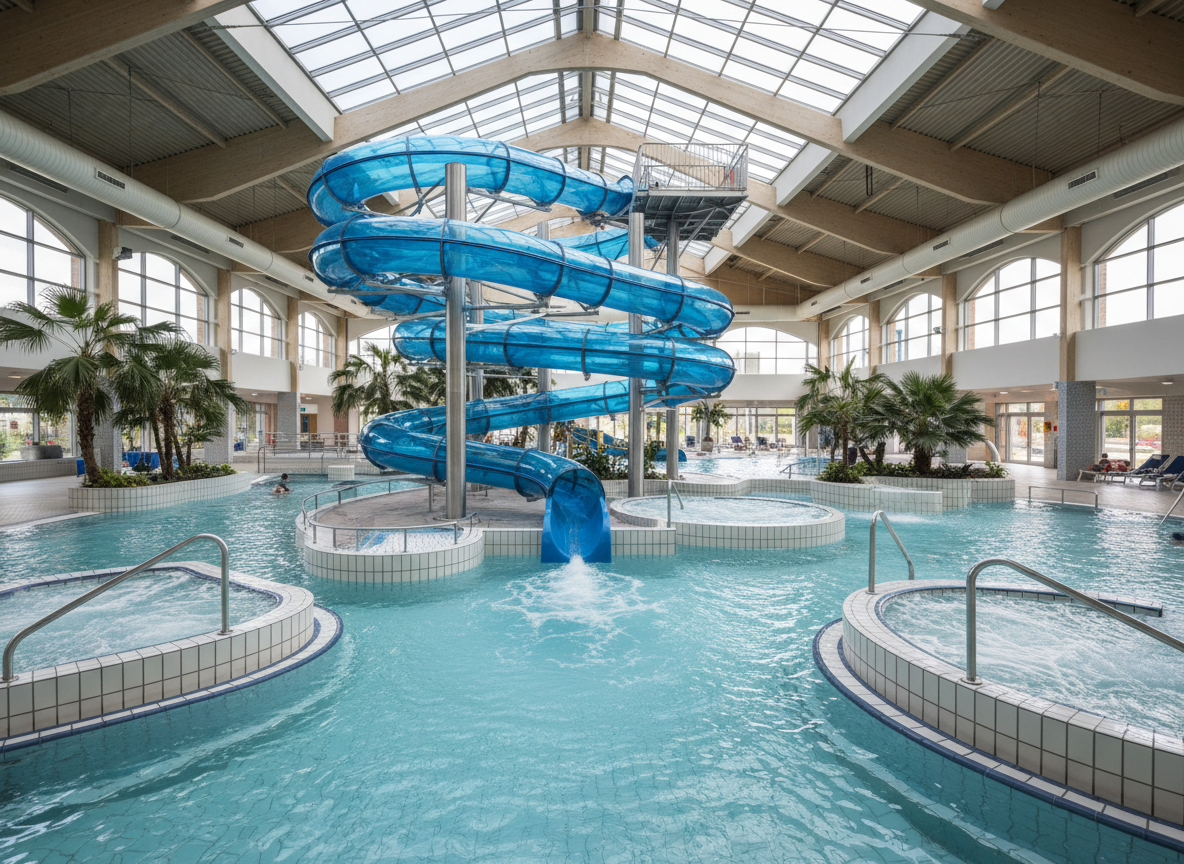
Fresh water → Pool → Surge tank → Circulation → Sand filter → Heat exchanger → Backwash
Indoor-pool water loop — 24/7 load, usable as thermal battery. Part of the glass family — like our glass BESS, biogas plant and CHP.
The slide has its own feed pump that creates the water film. It is often run continuously, although water is only needed during actual use.
With presence and schedule control the pump runs only on demand — a small but typical always-on load the AI switches off when nobody is sliding.
Pool water, circulation, filtration, backwash (the pool-water treatment standard):
Overview: The Glass Pool → · Markets: pool markets →
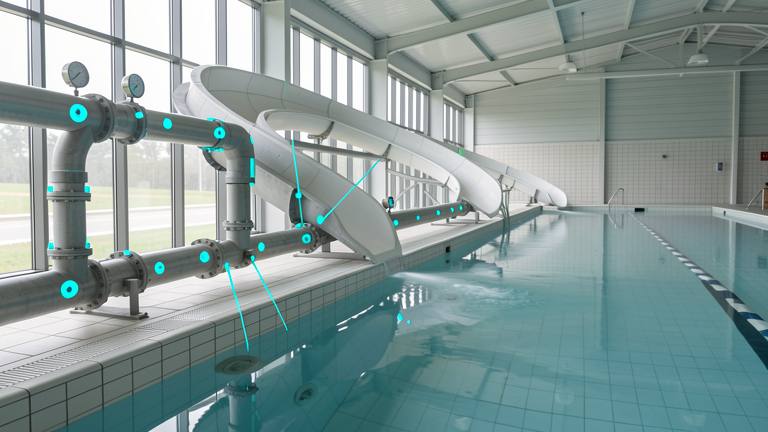
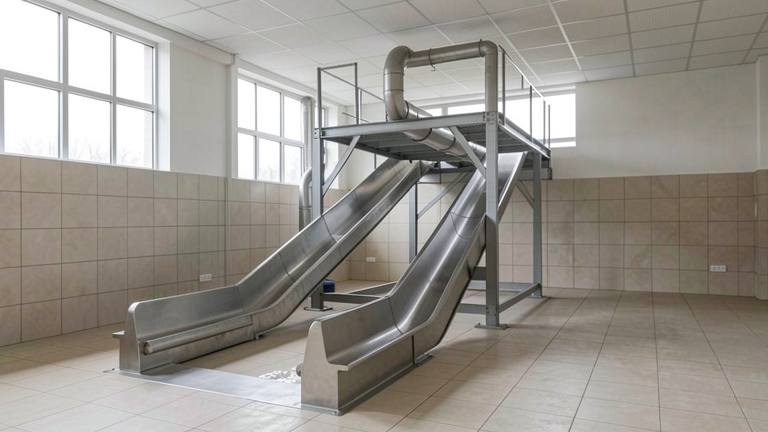
Monitored: continuously · slide pump running time
The scenario: The slide pump keeps running through hours when nobody slides. Nothing fails, nothing is flagged — the water simply circulates, and the meter counts.
Method proven on a live European reference aquatic center; presented anonymously.
Estimate from metered / design values. Zero-grid-import windows are real (metered).
Grounded in the applicable national standards for pool water treatment, plant energy performance and building energy performance. Same knowledge base as the European reference site; presented anonymously.
The applicable standard requires a minimum fresh-water make-up of 30 litres per visitor per day, independent of filter performance. This make-up dilutes metabolic products, urea and other substances introduced by bathers. At 1,500 visitors/week × 52 weeks that is 2,340 m³/a, which has to be heated from drinking-water temperature (~10 °C) to pool set-point (22-32 °C). At a 28 °C pool set-point this is roughly 50 MWh/a of heating energy for fresh water alone.
Basis: the applicable national standard
The applicable standard prescribes a maximum residence time of the pool water, depending on pool type: swimmer pools 4 h turnover, non-swimmer/paddling 1-2 h. This sets the minimum filter flow rate. For a 242 m³ lap pool at 4 h turnover that is 60.5 m³/h of filter capacity. Filter backwash once per day or above 0.5 bar differential pressure. Backwash water is warm (pool temperature − 3-5 K) and therefore a valuable heat-pump source.
Basis: the applicable national standard
Standard process combination for public pools: multi-layer sand filter + flocculation + chlorine-dioxide or chlorine-gas disinfection. Alternatives use activated carbon (treatment) or UV (disinfection). Sand-filter layering: fine sand 0.4-0.6 mm on top, gravel support layer below. Filter velocity max 30 m/h. Backwash at 50-60 m/h up-flow for 5-10 min, backwash volume approx. 5× the filter-bed volume.
Basis: the applicable national standard
Evaporation from the water surface is the dominant heat loss in an indoor pool (60-80 %). Smith/Löf variant of the Carrier formula: m_evap [kg/h] = β × A [m²] × (p_w_pool − p_w_hall) [kPa]. β-coefficient per the pool energy guideline (evaporation and ventilation) Tab. 4: 0.013 unused pool (covered), 0.040 normal use, 0.080 wave/diving pool. Evaporation enthalpy at 30 °C: 0.694 kWh/kg. Pool saturation vapour pressure via the Magnus formula: 611.2 × exp(17.62 × t / (243.12 + t)) Pa.
Basis: the applicable national standard
Outdoor pools have higher convection and radiation losses. Convection: h_conv = 4 + 11 × v_wind [W/(m²·K)] with v in m/s. At 1 m/s wind: h ≈ 15 W/(m²·K). Night radiation (clear sky): ~60 W/m² over a 10 h night. Solar gain during the day (global radiation × absorptivity 0.82 × 12 h) is a credit — in high summer it can drop the heat demand close to zero. A night cover reduces both evaporation (−85 %) and radiation loss (−90 %).
Basis: the applicable national standard
Stromfee.US licenses the pool & wellness HVAC AI — proven in Europe, deployed on your existing plant. Single property, portfolio or chain.
Request software license →