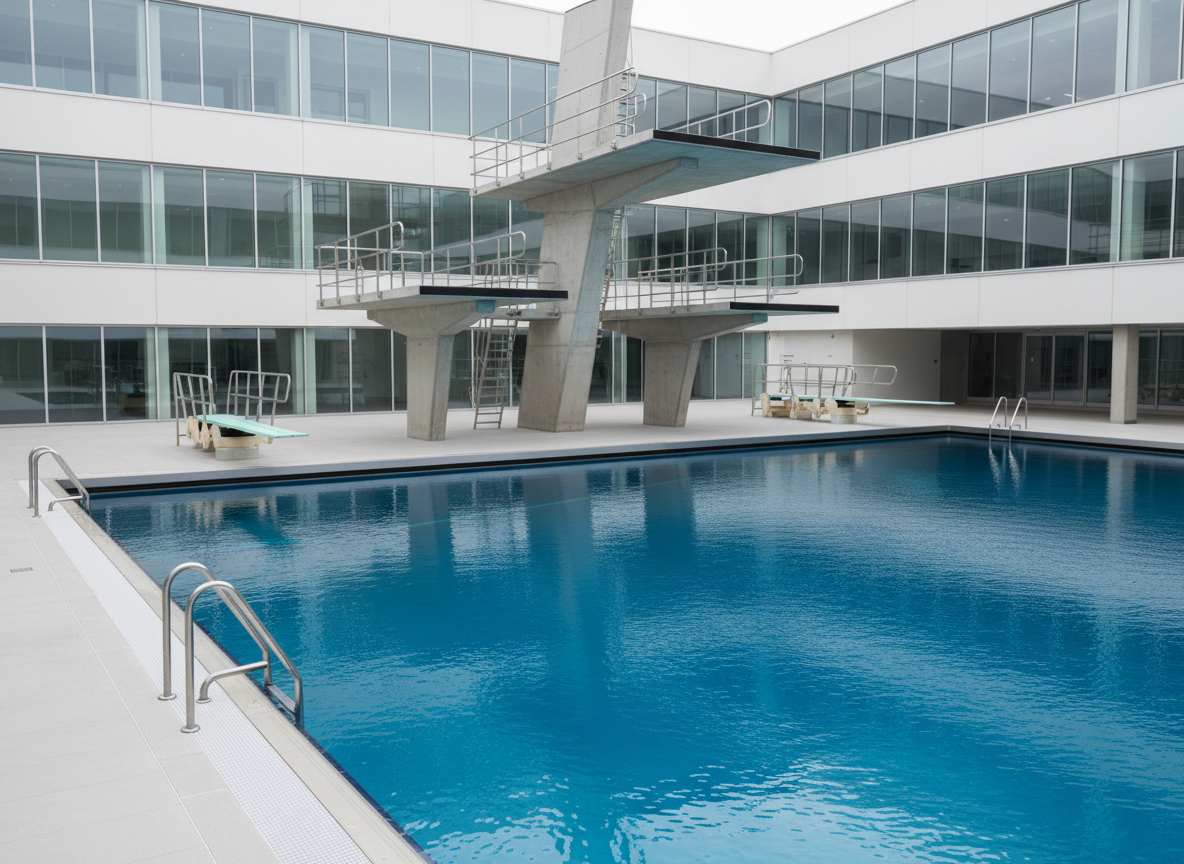
Outdoor diving pool
Outdoor-pool loop — seasonal; cover and solar gain are the lever. Part of the glass family — like our glass BESS, biogas plant and CHP.
Sun/wind → Outdoor pool → Cover → Circulation → Sand filter → Backwash
Outdoor-pool loop — seasonal; cover and solar gain are the lever. Part of the glass family — like our glass BESS, biogas plant and CHP.
The outdoor pool runs only in season (~week 20 to September). By day it gains heat from the sun (absorption ~0.82); at night it loses heat by radiation to the clear sky, and by day through wind (convection).
The biggest lever is the pool cover: it stops night radiation and evaporation. The AI weighs solar gain, wind and cover against each other and heats preferentially with PV surplus.
Solar gain, night radiation, wind, pool cover as the lever:
Overview: The Glass Pool → · Markets: pool markets →
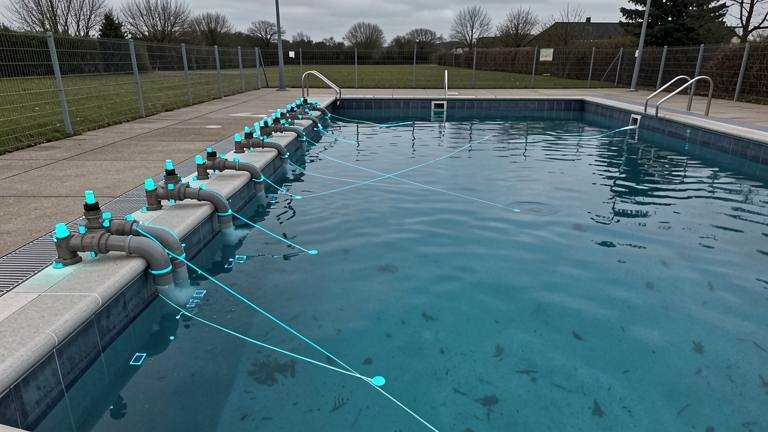
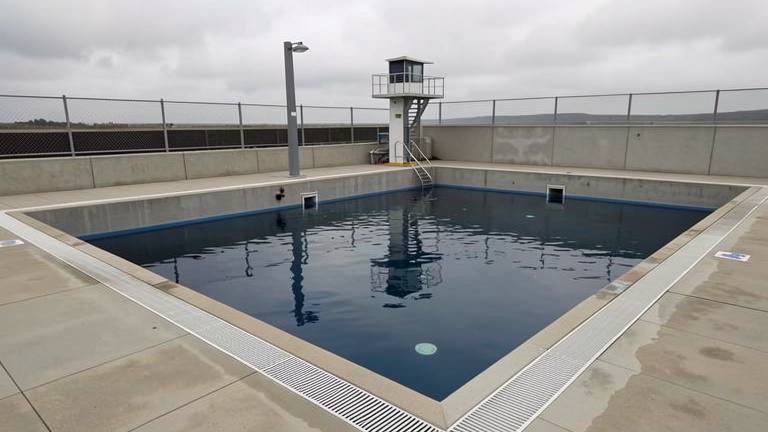
Monitored: continuously · turnover and mixing at depth
The scenario: The deep section mixes poorly. Measured at the surface everything is in order, while the water near the floor lags behind — the sample says yes, the basin says no.
Method proven on a live European reference aquatic center; presented anonymously.
Estimate from metered / design values. Zero-grid-import windows are real (metered).
Grounded in the applicable national standards for pool water treatment, plant energy performance and building energy performance. Same knowledge base as the European reference site; presented anonymously.
Night covers (slatted roll covers, floating blankets) cut in-season evaporation by 85 %, night radiation loss by 90 % and wind convection by 70 %. Material: PVC-laminated (cheap, 5-10 yr life) or polycarbonate slats (15-20 yr, 2-3× the price). For a 1,505 m² water surface at 100-150 €/m² including drive = 150-225 k€ — depending on how many separate systems are needed. A 40 % regional climate grant is possible.
Basis: the national pool-operators association + manufacturers (Grando, Coverstar, Hytex)
Outdoor pools have higher convection and radiation losses. Convection: h_conv = 4 + 11 × v_wind [W/(m²·K)] with v in m/s. At 1 m/s wind: h ≈ 15 W/(m²·K). Night radiation (clear sky): ~60 W/m² over a 10 h night. Solar gain during the day (global radiation × absorptivity 0.82 × 12 h) is a credit — in high summer it can drop the heat demand close to zero. A night cover reduces both evaporation (−85 %) and radiation loss (−90 %).
Basis: the applicable national standard
the national pool-operators association guideline R 60.03 on heating public outdoor pools: heat-up phase in April over 30 days, raising the set-point from 10 to 22 °C; slow heat-up (45 days) or solar absorbers as a pre-heat stage save energy. For 2,508 m³ of water × 12 K × 1.16 kWh/(m³·K) = 34,928 kWh — spread over 30 days that is 1,164 kWh/d of extra load. Recommendation: heat up via a pool heat pump on a warm source (backwash water already at 15 °C before season start) instead of a gas peak boiler. A pool cover shortens the time (solar gain by day, loss reduction by night).
Basis: the applicable national standard.03
the pool operating guideline fixes the order for refurbishments: 1) reduce losses (envelope, pool cover, insulate the surge tank, ventilation heat recovery), 2) recover heat (heat recovery, waste-water heat, filter backwash as a heat-pump source), 3) generate efficiently (heat pump > CHP > gas). This hierarchy is decisive for public grant applications: funders check whether losses were reduced before the generation investment. Concretely: insulate the surge tank, add an outdoor-pool night cover and service the ventilation heat recovery before or together with the heat-pump installation.
Basis: the applicable national standard.10
This regional climate-protection directive funds municipal climate investments at 40 %. It applies specifically to efficiency measures such as pool covers, LED lighting and pump replacement. It can be combined with ISEK provided the measures differ. Example: an outdoor-pool night cover (80 k€ investment, 17 k€/a saving) is ideal — payback with this grant is 2.8 years.
Basis: Regional climate-protection funding directive
Stromfee.US licenses the pool & wellness HVAC AI — proven in Europe, deployed on your existing plant. Single property, portfolio or chain.
Request software license →