Surge tank (outdoor)
Outdoor-pool loop — seasonal; cover and solar gain are the lever. Part of the glass family — like our glass BESS, biogas plant and CHP.
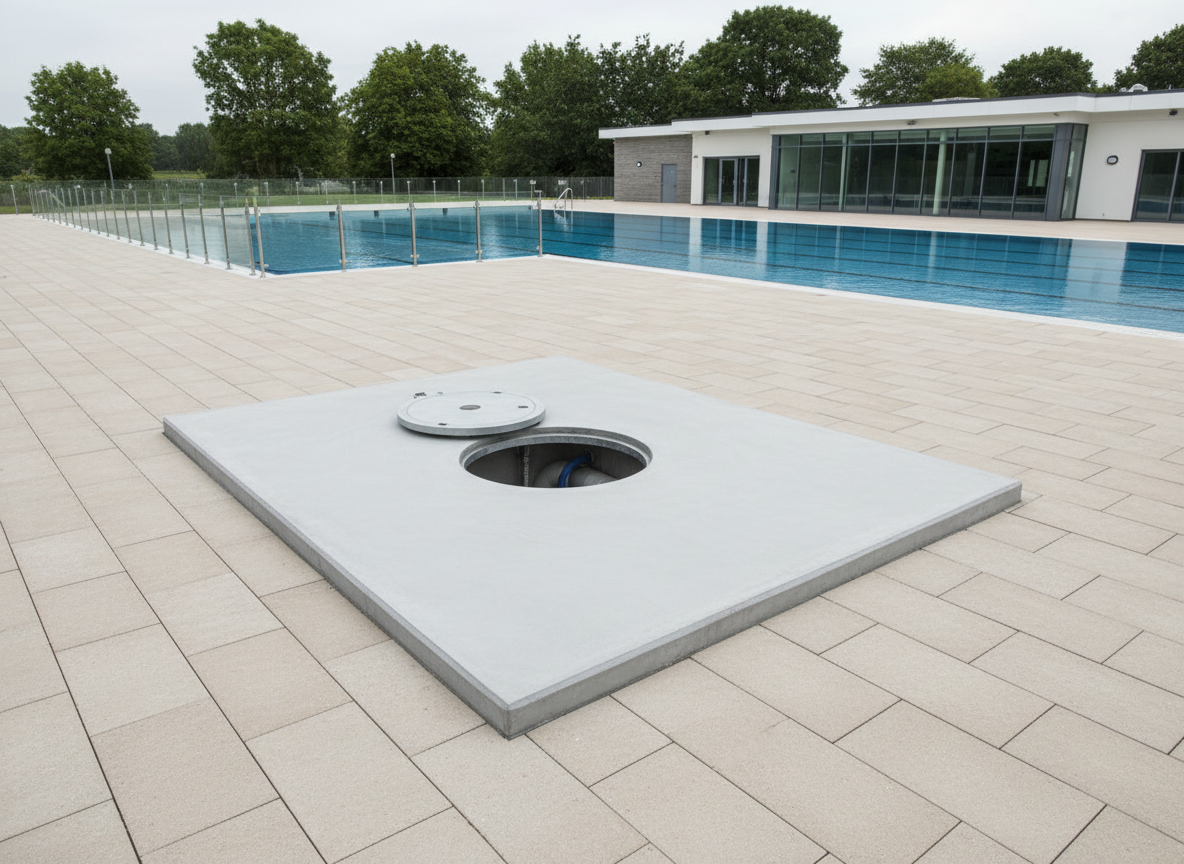
Sun/wind → Outdoor pool → Cover → Circulation → Sand filter → Backwash
Outdoor-pool loop — seasonal; cover and solar gain are the lever. Part of the glass family — like our glass BESS, biogas plant and CHP.
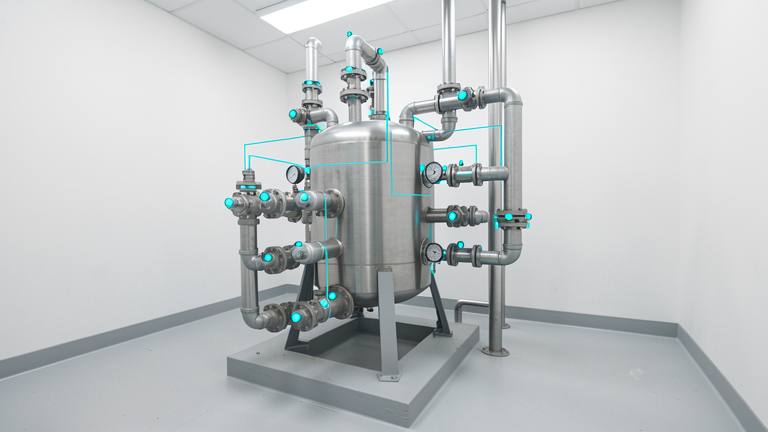
The surge/balance tank collects the water that spills over the gutters while people swim and buffers it for circulation. It is part of the pool-water treatment standard hygiene chain.
If uninsulated it loses heat continuously to the ground (U ≈ 2.0 W/m²K, ground 12 °C) — about 200 kWh/day around the clock at the reference site (chain K03). 80 mm of insulation cuts that by ~84 %.
Solar gain, night radiation, wind, pool cover as the lever:
Overview: The Glass Pool → · Markets: pool markets →
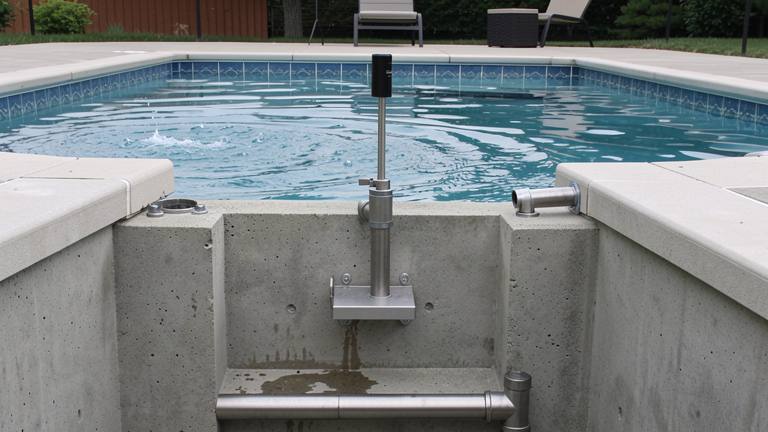
Monitored: continuously · level in the surge tank
The scenario: The level swing widens season by season. The tank still fills and empties, but its buffer no longer absorbs the bathing peak — the shortfall shows up downstream, not here.
Method proven on a live European reference aquatic center; presented anonymously.
Estimate from metered / design values. Zero-grid-import windows are real (metered).
Grounded in the applicable national standards for pool water treatment, plant energy performance and building energy performance. Same knowledge base as the European reference site; presented anonymously.
Uninsulated surge tanks (steel or concrete, in the ground) lose heat continuously. Uninsulated U-value: 2.0 W/(m²·K) against ground (12 °C). Insulating with 80 mm PUR rigid foam reduces U to 0.32 W/(m²·K) — a factor of 6. Investment: 250-350 €/m² of tank wall including water-tightness and mould protection. For a 55 m² surge tank: 124 kWh/d uninsulated → 20 kWh/d insulated = 38 MWh/a saved, ~3,400 €/a in gas. Plus avoidance of condensation corrosion on the outside.
Basis: Practice (KSB, FLL)
the pool operating guideline fixes the order for refurbishments: 1) reduce losses (envelope, pool cover, insulate the surge tank, ventilation heat recovery), 2) recover heat (heat recovery, waste-water heat, filter backwash as a heat-pump source), 3) generate efficiently (heat pump > CHP > gas). This hierarchy is decisive for public grant applications: funders check whether losses were reduced before the generation investment. Concretely: insulate the surge tank, add an outdoor-pool night cover and service the ventilation heat recovery before or together with the heat-pump installation.
Basis: the applicable national standard.10
Evaporation from the water surface is the dominant heat loss in an indoor pool (60-80 %). Smith/Löf variant of the Carrier formula: m_evap [kg/h] = β × A [m²] × (p_w_pool − p_w_hall) [kPa]. β-coefficient per the pool energy guideline (evaporation and ventilation) Tab. 4: 0.013 unused pool (covered), 0.040 normal use, 0.080 wave/diving pool. Evaporation enthalpy at 30 °C: 0.694 kWh/kg. Pool saturation vapour pressure via the Magnus formula: 611.2 × exp(17.62 × t / (243.12 + t)) Pa.
Basis: the applicable national standard
Outdoor pools have higher convection and radiation losses. Convection: h_conv = 4 + 11 × v_wind [W/(m²·K)] with v in m/s. At 1 m/s wind: h ≈ 15 W/(m²·K). Night radiation (clear sky): ~60 W/m² over a 10 h night. Solar gain during the day (global radiation × absorptivity 0.82 × 12 h) is a credit — in high summer it can drop the heat demand close to zero. A night cover reduces both evaporation (−85 %) and radiation loss (−90 %).
Basis: the applicable national standard
the national pool-operators association guideline R 60.03 on heating public outdoor pools: heat-up phase in April over 30 days, raising the set-point from 10 to 22 °C; slow heat-up (45 days) or solar absorbers as a pre-heat stage save energy. For 2,508 m³ of water × 12 K × 1.16 kWh/(m³·K) = 34,928 kWh — spread over 30 days that is 1,164 kWh/d of extra load. Recommendation: heat up via a pool heat pump on a warm source (backwash water already at 15 °C before season start) instead of a gas peak boiler. A pool cover shortens the time (solar gain by day, loss reduction by night).
Basis: the applicable national standard.03
Stromfee.US licenses the pool & wellness HVAC AI — proven in Europe, deployed on your existing plant. Single property, portfolio or chain.
Request software license →