Sand filter (outdoor)
Outdoor-pool loop — seasonal; cover and solar gain are the lever. Part of the glass family — like our glass BESS, biogas plant and CHP.
Sun/wind → Outdoor pool → Cover → Circulation → Sand filter → Backwash
Outdoor-pool loop — seasonal; cover and solar gain are the lever. Part of the glass family — like our glass BESS, biogas plant and CHP.
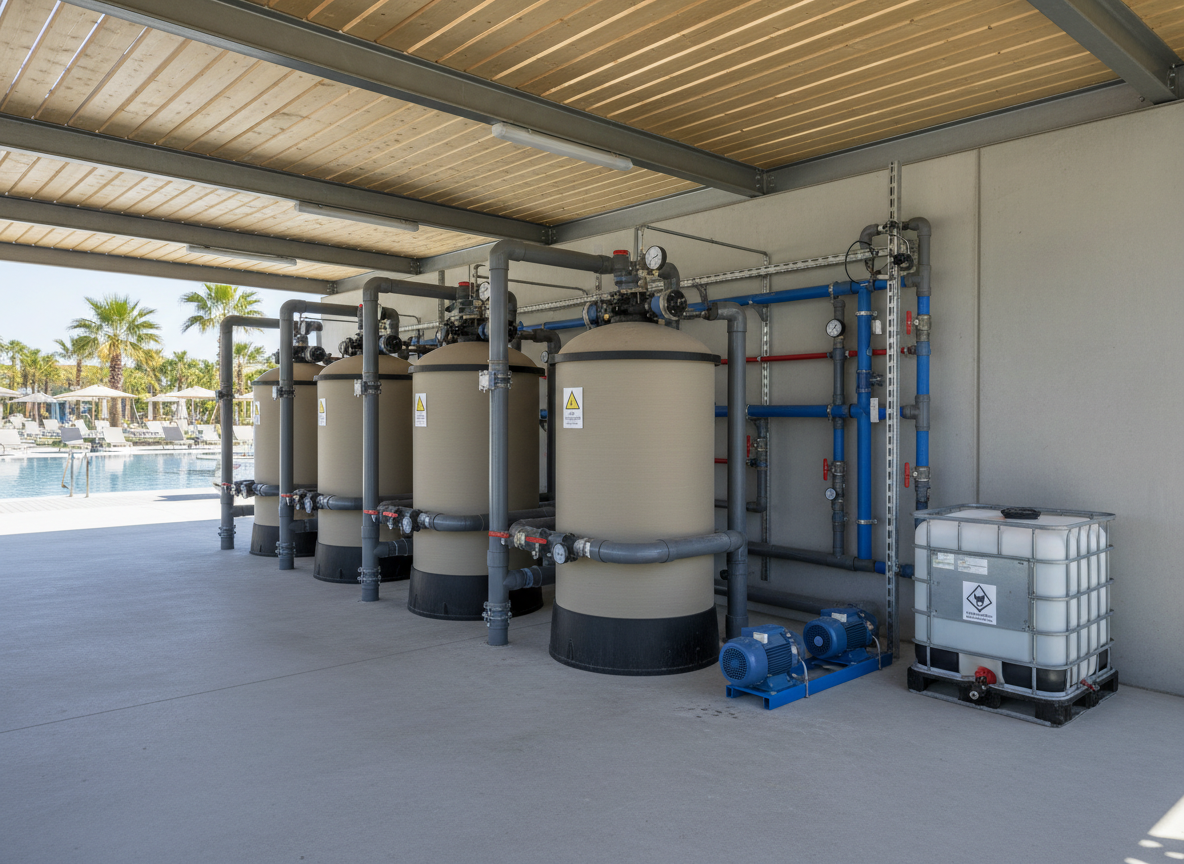
The sand filter mechanically cleans the circulated pool water through a sand bed (the pool-water treatment standard). Over time it clogs and the flow resistance rises.
From resistance and turbidity the AI detects when a backwash is truly needed — instead of fixed schedules. Every avoided unnecessary backwash saves water, heat and chemistry.
Solar gain, night radiation, wind, pool cover as the lever:
Overview: The Glass Pool → · Markets: pool markets →
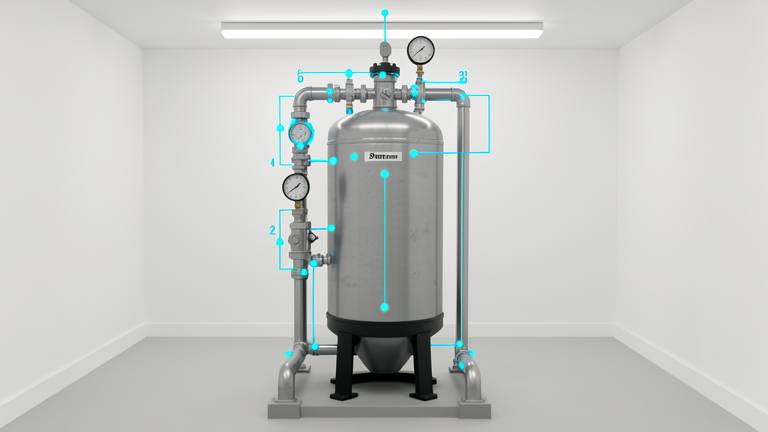
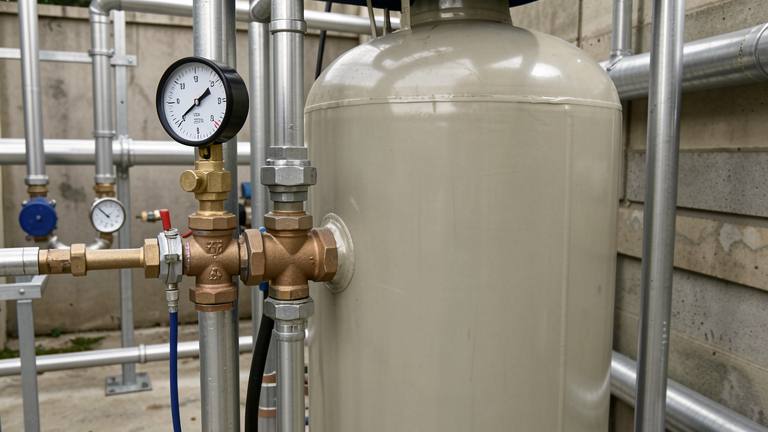
Monitored: continuously · differential pressure over the filter bed
The scenario: Differential pressure creeps up over weeks and stays below the alarm threshold the whole time. Filtration quality drops long before anything is flagged — the backwash comes too late.
Method proven on a live European reference aquatic center; presented anonymously.
Estimate from metered / design values. Zero-grid-import windows are real (metered).
Grounded in the applicable national standards for pool water treatment, plant energy performance and building energy performance. Same knowledge base as the European reference site; presented anonymously.
Standard process combination for public pools: multi-layer sand filter + flocculation + chlorine-dioxide or chlorine-gas disinfection. Alternatives use activated carbon (treatment) or UV (disinfection). Sand-filter layering: fine sand 0.4-0.6 mm on top, gravel support layer below. Filter velocity max 30 m/h. Backwash at 50-60 m/h up-flow for 5-10 min, backwash volume approx. 5× the filter-bed volume.
Basis: the applicable national standard
The applicable standard prescribes a maximum residence time of the pool water, depending on pool type: swimmer pools 4 h turnover, non-swimmer/paddling 1-2 h. This sets the minimum filter flow rate. For a 242 m³ lap pool at 4 h turnover that is 60.5 m³/h of filter capacity. Filter backwash once per day or above 0.5 bar differential pressure. Backwash water is warm (pool temperature − 3-5 K) and therefore a valuable heat-pump source.
Basis: the applicable national standard
Evaporation from the water surface is the dominant heat loss in an indoor pool (60-80 %). Smith/Löf variant of the Carrier formula: m_evap [kg/h] = β × A [m²] × (p_w_pool − p_w_hall) [kPa]. β-coefficient per the pool energy guideline (evaporation and ventilation) Tab. 4: 0.013 unused pool (covered), 0.040 normal use, 0.080 wave/diving pool. Evaporation enthalpy at 30 °C: 0.694 kWh/kg. Pool saturation vapour pressure via the Magnus formula: 611.2 × exp(17.62 × t / (243.12 + t)) Pa.
Basis: the applicable national standard
Outdoor pools have higher convection and radiation losses. Convection: h_conv = 4 + 11 × v_wind [W/(m²·K)] with v in m/s. At 1 m/s wind: h ≈ 15 W/(m²·K). Night radiation (clear sky): ~60 W/m² over a 10 h night. Solar gain during the day (global radiation × absorptivity 0.82 × 12 h) is a credit — in high summer it can drop the heat demand close to zero. A night cover reduces both evaporation (−85 %) and radiation loss (−90 %).
Basis: the applicable national standard
the national pool-operators association guideline R 60.03 on heating public outdoor pools: heat-up phase in April over 30 days, raising the set-point from 10 to 22 °C; slow heat-up (45 days) or solar absorbers as a pre-heat stage save energy. For 2,508 m³ of water × 12 K × 1.16 kWh/(m³·K) = 34,928 kWh — spread over 30 days that is 1,164 kWh/d of extra load. Recommendation: heat up via a pool heat pump on a warm source (backwash water already at 15 °C before season start) instead of a gas peak boiler. A pool cover shortens the time (solar gain by day, loss reduction by night).
Basis: the applicable national standard.03
Stromfee.US licenses the pool & wellness HVAC AI — proven in Europe, deployed on your existing plant. Single property, portfolio or chain.
Request software license →